Communication - Press
Manufacturing & Agribusiness Outlook 2026
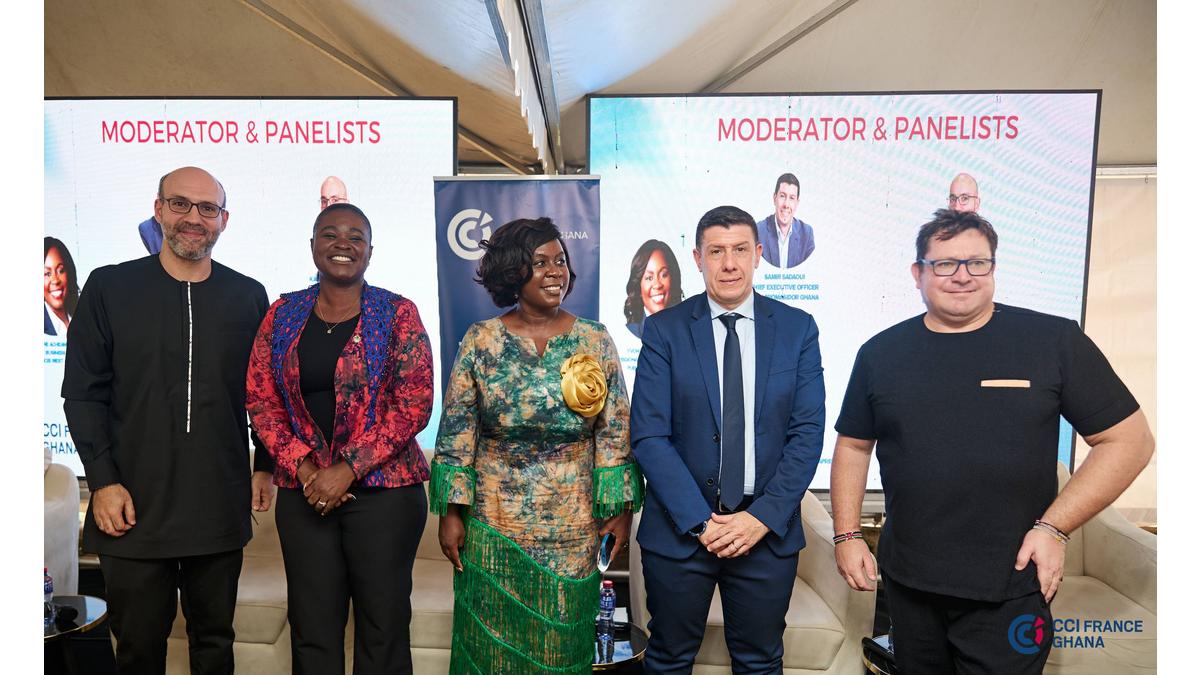
Manufacturing & Agribusiness Outlook 2026
The French Chamber of Commerce and Industry in Ghana (CCIFG) has successfully held its maiden Manufacturing & Agribusiness Outlook 2026 on Wednesday 3rd June, 2026, at the Residence of the French Ambassador in Accra. It was under the theme, “Driving Industrial and Agricultural Transformation in Ghana: Opportunities, Challenges, and Strategic Partnerships in the Manufacturing and Agribusiness sectors”.
In his opening remarks, the Board President of CCIFG, Mr. Guillaume Valence said the board views the manufacturing and agribusiness sectors as the cornerstones of economic resilience and positions Ghana to leverage the African Continental Free Trade Area (AFCFTA). However, in doing so, Mr. Guillaume called for the need to address the structural and financial bottlenecks that limit corporate competitiveness.
The main focus of the breakfast meeting was to discuss opportunities, challenges and collaborative solutions for advancing Ghana’s manufacturing and agribusiness sectors in Ghana and France.
Representing the Ghana Free Zones Authority, the Corporate Affairs Director, Dr. Patience Agbleze Acorlor advocated an urgent wake up call to state agencies, warning that, a severe lack of institutional collaboration will paralyze the Country’s industrial growth. According to Dr. Acorlor, while the nation possesses robust economic policies, state institutions tasked with executing them are actively undermining each other by operating in total isolation.
Her call was corroborated by the representative from the Ghana Revenue Authority, Mr. Lawrence Hotsonyame who indicated that, under the current fragmented framework, manufacturing and agribusiness firms often struggle to track parallel incentive structures handled separately by isolated agencies, thus, the need for the collaboration so that they will be able to know whichever concessions are available at the Ghana Free Zones and the Ghana Investment Promotion Centre (GIPC).
Delivering a comprehensive presentation on behalf of the GIPC, Mr. Benjamin Okyere Boakye mapped out a vast landscape of untapped investment opportunities across Ghana, detailing a $7.2 billion gap in irrigation systems needed by 2047, where over 88% of farmable land remains unused. He highlighted massive, strategically targeted government projects designed to cut millions in imports, including the $600 million Volo Pato Agro-Industrial Hub in the Volta Region for rice and cassava, the $120 million Senga Integrated Agro Pack in the Northern Region, and the $200 million National Poultry and Feed Corridor aiming to replace $380 million in annual poultry imports. Mr. Boakye further unveiled emerging high-growth landscapes like the newly licensed medicinal cannabis sector and a rapidly expanding crypto transaction market that cleared over $10 billion in 2025. To aggressively drive these public-private collaborations, he emphasized that GIPC is facilitating the national 24-hour economy initiative by offering a fast-tracked, 24-hour investor registration service alongside 100% capital repatriation protections and a heavily incentivized 1% corporate tax rate for the first five years in agro-processing.
Contributing to the dialogue on modernization, Mr. Kassem Odaymat, Chief Operating Officer of O Group, highlighted a monumental shift in market dynamics, stating that businesses can no longer ignore that modern customers are highly informed and know exactly what they want. He emphasized that companies can no longer simply dictate what they sell, and must aggressively invest in skills development and data cleansing to navigate rapid technological changes.
Mr. Samir Sadaoui, CEO of Promasidor Ghana, added that manufacturing has shifted from a traditional "relay race" to a "synchronized dance" where the consumer sits firmly at the center of decision-making. He noted that this reality requires companies to stay agile, utilizing a "multi-local" approach to test and fine-tune products to meet local tastes rather than simply copying and pasting strategies.
Representing Guinness Ghana Breweries PLC, Mrs. Ranstina Opare-Saforo shared how the boundaries between manufacturing and agribusiness have completely blurred, noting that Guinness has heavily embedded itself into the agro-value chain by replacing imported malt with locally sourced sorghum, supporting over 30,000 farmers in the Northern Region. She also reflected on their ongoing corporate transition, stating that integrating into the French-based Castel Group has successfully blended world-class brand innovation with extensive industrial capacity.
Mr. Greg Pitt, Deputy Managing Director of Kasapreko PLC, offered a masterclass on regional competitiveness, explaining that global success requires building a strong ecosystem around a brand. He noted that market realities and rigid regulations often make it more practical to set up offices and manufacture directly within foreign territories rather than trying to navigate cross-border export bottlenecks.
The key outcome from the Manufacturing and Agribusiness Outlook 2026 included, the urgent call for Institutional collaboration, advocacy for a “Single Document” Tax regime, focus on localizing the African Continental Free Trade Area (AfCFTA), strategic shifting to a customer-centric, agile approach, and prioritizing human capital over independent automation, as all speakers agreed that advanced technologies and AI mean nothing if you do not bring your people along with you on the journey.
This breakfast meeting, hosted by CCIFG, brought together Ghanaian and French players in manufacturing and agribusiness. It created a space for strategic talks, sharing insights, promoting investment and building partnerships, in line with CCIFG’s goal of growing a vibrant France-Ghana business community.
Click here to view photos https://ccifranceghana55.pixieset.com/manufacturingandagribusinessoutlook2026/